
Identity Verification
Confirm a person is who they claim to be
Check the document, match the face or fingerprint, and confirm the record behind it.
The verification flow
Is the document real, is the holder the owner, is the record valid?
Read what the document actually says
The credential is scanned or tapped: MRZ, barcode and printed data are read in visible, infrared and UV light, and the chip is opened where one is present. Nothing is typed by hand, so nothing is mistyped.

Read what the document actually says
The credential is scanned or tapped: MRZ, barcode and printed data are read in visible, infrared and UV light, and the chip is opened where one is present. Nothing is typed by hand, so nothing is mistyped.
Read what the document actually says
The credential is scanned or tapped: MRZ, barcode and printed data are read in visible, infrared and UV light, and the chip is opened where one is present. Nothing is typed by hand, so nothing is mistyped.
Prove the credential is genuine and Valid
Security features are inspected and the chip is cryptographically authenticated against the issuing authority’s certificates. A cloned chip or an altered data page fails here, before any biometric is captured.

Prove the credential is genuine and Valid
Security features are inspected and the chip is cryptographically authenticated against the issuing authority’s certificates. A cloned chip or an altered data page fails here, before any biometric is captured.
Prove the credential is genuine and Valid
Security features are inspected and the chip is cryptographically authenticated against the issuing authority’s certificates. A cloned chip or an altered data page fails here, before any biometric is captured.
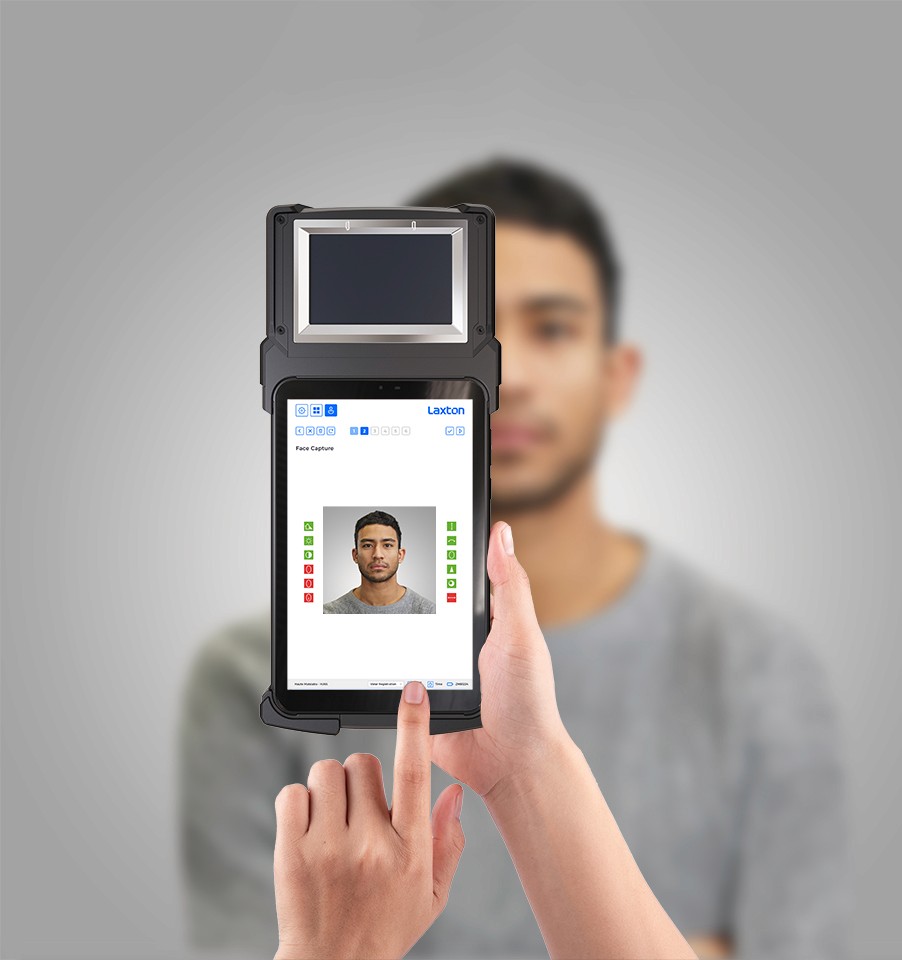
Capture the person in front of you
A live face, fingerprint or iris sample is captured with quality feedback to the operator, and liveness detection confirms a real person is present rather than a photo, a screen or a replayed sample.
Capture the person in front of you
A live face, fingerprint or iris sample is captured with quality feedback to the operator, and liveness detection confirms a real person is present rather than a photo, a screen or a replayed sample.
Capture the person in front of you
A live face, fingerprint or iris sample is captured with quality feedback to the operator, and liveness detection confirms a real person is present rather than a photo, a screen or a replayed sample.
Match the person to the credential
The captured sample is compared 1:1 against the biometric on the chip or in the identity register. Match thresholds and the fallback order between modalities are set per programme, so a worn fingerprint does not become a refusal.
Match the person to the credential
The captured sample is compared 1:1 against the biometric on the chip or in the identity register. Match thresholds and the fallback order between modalities are set per programme, so a worn fingerprint does not become a refusal.
Match the person to the credential
The captured sample is compared 1:1 against the biometric on the chip or in the identity register. Match thresholds and the fallback order between modalities are set per programme, so a worn fingerprint does not become a refusal.
One verdict, with its evidence
The officer or service gets a clear verified or not verified, the reason behind it, and only the attributes they are entitled to see. The full check is logged with operator, device, location and time.
One verdict, with its evidence
The officer or service gets a clear verified or not verified, the reason behind it, and only the attributes they are entitled to see. The full check is logged with operator, device, location and time.
One verdict, with its evidence
The officer or service gets a clear verified or not verified, the reason behind it, and only the attributes they are entitled to see. The full check is logged with operator, device, location and time.

SECURE DOCUMENT AUTHENTICATION
Three light sources. One verdict on authenticity.
Scan any passport or ID card and cross-reference it with a global database of IDs to ensure the document is authentic.

White

Ultra Violet

Infra-red
SECURE DOCUMENT AUTHENTICATION
Three light sources. One verdict on authenticity.
Scan any passport or ID card and cross-reference it with a global database of IDs to ensure the document is authentic.
White
Ultra Violet
Infra-red
SECURE DOCUMENT AUTHENTICATION
Three light sources. One verdict on authenticity.
Scan any passport or ID card and cross-reference it with a global database of IDs to ensure the document is authentic.
White
Ultra Violet
Infra-red
What the check covers
Layered checks, one verdict
document_scanner
Document capture
Full-page scanning in visible, infrared and UV light reads the document as printed and as designed to be inspected.
key
Chip authentication
Passive and active authentication verify the signature on the chip data and prove the chip itself is not a clone.
fingerprint
Biometric match
Face, fingerprint and iris matching against the chip or the register, with thresholds set to the programme’s risk appetite.
visibility
Liveness detection
Presentation-attack detection separates a live person from a printed photo, a screen replay or a mask.
wifi_off
Offline verification
Signed data on the chip or a secure QR lets a device verify with no connection, then reconcile when it reconnects.
history
Audit trail
Every check is logged with the operator, device, location, time and result — evidence when a decision is questioned.
Where verification happens
Solutions for the counter, the border and the field
Service counters
Civil registry, social benefits, health and banking desks confirm entitlement before a service is granted.
Self-service
Citizens verify themselves through a phone or kiosk, with liveness checks standing in for the officer.
Border control
Full eMRTD chip authentication and watchlist screening in the seconds a traveller stands at the booth.
Mobile and field
Rugged handhelds verify voters, patients and beneficiaries where there is no desk and often no network.
Frequently Asked Questions
What is ID verification?
Verification confirms that a person is who they claim to be by matching them against their identity record, through biometrics, the credential itself, or both, and returning a clear pass or fail result.
Which biometrics can be used to verify identity?
Fingerprint, face, and iris. One-to-one biometric matching confirms identity against the holder’s enrolled record and removes reliance on the physical credential alone.
How does Laxton detect forged or tampered documents?
Verification devices read and validate document security features and chip data, including cryptographic keys, confirming a credential is authentic, unaltered, and issued by the legitimate authority.
Is every verification recorded?
Yes. Each event is logged with timestamp and operator ID, producing a complete, tamper-evident audit trail that supports transparency, fraud detection, and statutory review.
What is the difference between verification and identification?
Verification is a one-to-one check, confirming a person against their own record. Identification is a one-to-many search, finding a person within an entire database. Verification answers “are you who you say you are?”
Can verification work without internet?
Yes. Devices verify identity fully offline against pre-loaded records, with results logged and reconciled once connectivity is restored, supporting reliable checks in remote locations.
How is voter verification handled on election day?
Electronic poll books confirm each voter against the polling station’s register by name, ID number, or biometric search. Each voter is marked as attended on verification, preventing double-voting.
What is ID verification?
Verification confirms that a person is who they claim to be by matching them against their identity record, through biometrics, the credential itself, or both, and returning a clear pass or fail result.
What is the difference between verification and identification?
Verification is a one-to-one check, confirming a person against their own record. Identification is a one-to-many search, finding a person within an entire database. Verification answers “are you who you say you are?”
Which biometrics can be used to verify identity?
Fingerprint, face, and iris. One-to-one biometric matching confirms identity against the holder’s enrolled record and removes reliance on the physical credential alone.
Can verification work without internet?
Yes. Devices verify identity fully offline against pre-loaded records, with results logged and reconciled once connectivity is restored, supporting reliable checks in remote locations.
How does Laxton detect forged or tampered documents?
Verification devices read and validate document security features and chip data, including cryptographic keys, confirming a credential is authentic, unaltered, and issued by the legitimate authority.
How is voter verification handled on election day?
Electronic poll books confirm each voter against the polling station’s register by name, ID number, or biometric search. Each voter is marked as attended on verification, preventing double-voting.
Is every verification recorded?
Yes. Each event is logged with timestamp and operator ID, producing a complete, tamper-evident audit trail that supports transparency, fraud detection, and statutory review.
What is ID verification?
Verification confirms that a person is who they claim to be by matching them against their identity record, through biometrics, the credential itself, or both, and returning a clear pass or fail result.
Which biometrics can be used to verify identity?
Fingerprint, face, and iris. One-to-one biometric matching confirms identity against the holder’s enrolled record and removes reliance on the physical credential alone.
How does Laxton detect forged or tampered documents?
Verification devices read and validate document security features and chip data, including cryptographic keys, confirming a credential is authentic, unaltered, and issued by the legitimate authority.
Is every verification recorded?
Yes. Each event is logged with timestamp and operator ID, producing a complete, tamper-evident audit trail that supports transparency, fraud detection, and statutory review.
What is the difference between verification and identification?
Verification is a one-to-one check, confirming a person against their own record. Identification is a one-to-many search, finding a person within an entire database. Verification answers “are you who you say you are?”
Can verification work without internet?
Yes. Devices verify identity fully offline against pre-loaded records, with results logged and reconciled once connectivity is restored, supporting reliable checks in remote locations.
How is voter verification handled on election day?
Electronic poll books confirm each voter against the polling station’s register by name, ID number, or biometric search. Each voter is marked as attended on verification, preventing double-voting.
SOLUTIONS
PRODUCTS
RESOURCES
Company
Corporate Responsibility

Laxton is a DNP Company
DNP is a leading global innovator in secure printing, smart communication, and digital solutions.
SOLUTIONS
PRODUCTS
RESOURCES
Company
Corporate Responsibility
Laxton is a DNP Company
DNP is a leading global innovator in secure printing, smart communication, and digital solutions.
SOLUTIONS
PRODUCTS
RESOURCES
Company
Corporate Responsibility
Laxton is a DNP Company
DNP is a leading global innovator in secure printing, smart communication, and digital solutions.