Record 16.8 million voters registered for Mozambique’s 2024 elections
16.8 million
Voters registered
29%
More voters registered than in the previous elections
7,000
Registration centres
In a historic achievement, Mozambique successfully registered 16.8 million voters for the 2024 elections, breaking previous records and setting a new benchmark for electoral participation in the country. This represents a remarkable 29% increase from the 2018/2019 elections, underscoring the impact of the technology used to register all the voters.
Project
Sector: Voter ID
Region: Mozambique
Year: 2024
Building on the 2018/2019 elections
Laxton’s election solutions have supported Mozambique’s recent elections. Working with the Technical Secretariat of the Electoral Administration (STAE), Laxton has helped make voter registration more accessible and efficient. The 2018/2019 elections, with 13 million voters registered and a 92% turnout, showed that this work paid off and strengthened public trust in the government and the electoral process.
Over the past three years, Laxton has continued to support STAE with technology and operational assistance, and has improved voter enrolment and verification systems to meet international standards for electoral integrity and transparency.
A target of 15 million voters
To strengthen the legitimacy of the 2024 elections, STAE aimed to expand voter registration to over 15 million citizens, focusing on inclusivity and accessibility. Reaching voters in remote and underserved regions was key to that goal.
Overcoming logistical challenges
With two-thirds of Mozambique’s population living in rural areas, establishing voter registration centres was challenging. Rugged terrain, poor infrastructure and conflict zones made logistics harder still. To protect every citizen’s right to vote, STAE took several steps:
Equipment built for tough conditions
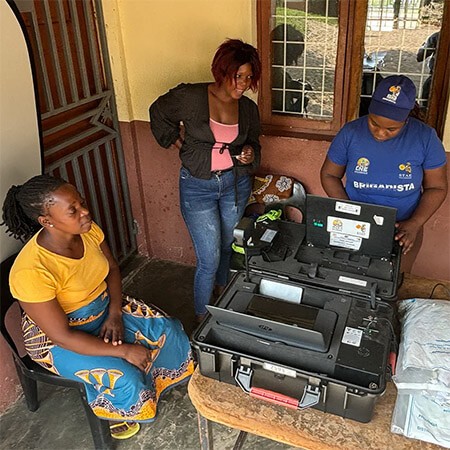
Laxton provided durable, weather-resistant equipment that can withstand Mozambique’s challenging environments. These environments are characterised by high humidity, heavy seasonal rainfall, poor infrastructure, dust and limited electricity and internet in remote areas. The compact and mobile registration kits were encased in IP67 rugged cases, making them easily transportable and suitable for operation in rural, sandy regions. The rugged design protected against moisture, dust and heat, keeping registration running across the country. Solar panels powered the equipment in areas without electricity. Because it also worked offline, registration and card issuance could go ahead anywhere, helping many first-time voters take part.
Registration centres where voters are
To reach as many voters as possible, STAE placed registration centres in accessible, busy places such as schools. Mobile registration units were also deployed to reach sparsely populated and remote regions, staying for about a week in each location before moving on. This brought more voters into the process across the country.
Voter registration for Mozambicans abroad
For Mozambicans living abroad, STAE set up over 100 registration centres in places such as South Africa, Tanzania and Europe. The aim was to register around 2 million overseas voters so they could take part in the elections.
What Laxton supplied
Laxton provided:
Voter ID printer kit
For on-the-spot voter ID card production and issuanceSupporting accessories
Solar panels and photo backdrops, so work can continue in areas without electricityIdentity registration software
To manage and secure voter data.Central server and software
For centralised data management and integrationIn-country training programmes
Ensuring local teams were well-equipped to operate and maintain the equipment and systemsNationwide technical support and warranty services
Providing ongoing support and ensuring system reliability

Long-lasting equipment lowers costs
Because Laxton’s equipment lasts, it has significantly reduced the cost per registration (CPR) and stays economical over the long term. This matters for future elections and for Mozambique’s wider national identity initiatives.

Secure systems and fast fixes
Laxton’s voter registration system used biometric and encryption technology to prevent manipulation of the electoral process. A ticketing platform was also developed for real-time monitoring and communication, so the in-country team could resolve any issue within 24 hours and keep downtime to a minimum.
Durable PVC voter ID cards
Only 9% of Mozambicans have a national ID, making the voter ID card a valuable alternative for most. Durable PVC voter ID cards could remove the need to re-register in future election cycles, saving voters time and reducing administrative work and cost.

Training local teams and refining the process
Laxton used a “train-the-trainer” approach to pass knowledge quickly to local teams. Local technicians can now handle system upgrades, maintenance and repairs themselves, building lasting technical skills within the organisation.
Pilot registration drives conducted in early 2023 across three provinces allowed Laxton to fine-tune the registration process. These pilots highlighted specific challenges, such as capturing accurate biometric data in poorly lit registration centres. Laxton responded with software updates and hardware adjustments to prepare the system for the national rollout.

Secure data transmission from remote areas
In rural regions with poor connectivity, Starlink provided high-speed internet so voter data could be sent securely to the central server in Maputo. After registration, the data was managed centrally on Laxton’s Athena platform with an Automated Biometric Identification System (ABIS), which used matching algorithms to prevent fraud and keep the voter roll credible.
A solid foundation for the future of Mozambique’s democracy
This voter registration project was a collaboration between STAE, NEC and Laxton. The record registration of 16.8 million voters secured broad participation and laid the groundwork for wider digital identity in Mozambique. The improvements in voter registration support an inclusive democratic process for the 2024 elections and beyond.